
Culture-competence nexus

Q: What prompted your move to Fiji – and what differences have you observed compared to Sri Lanka?
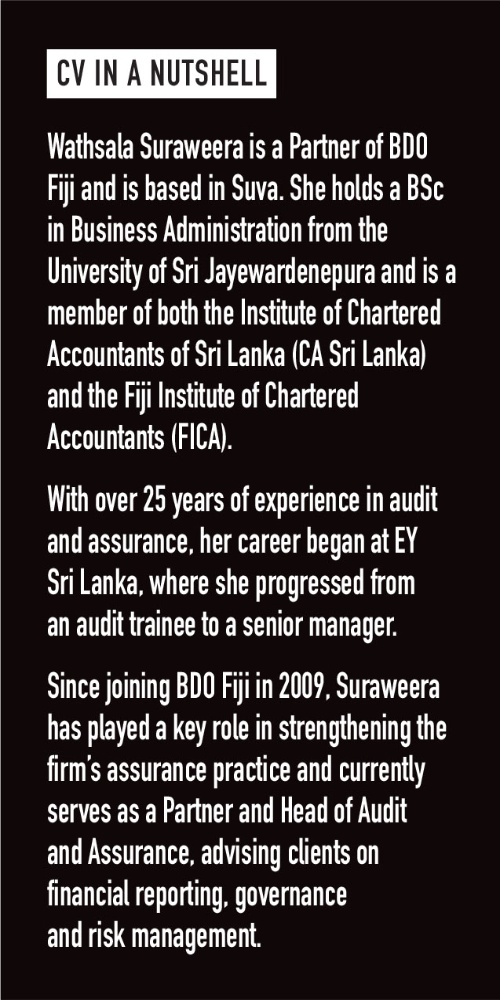
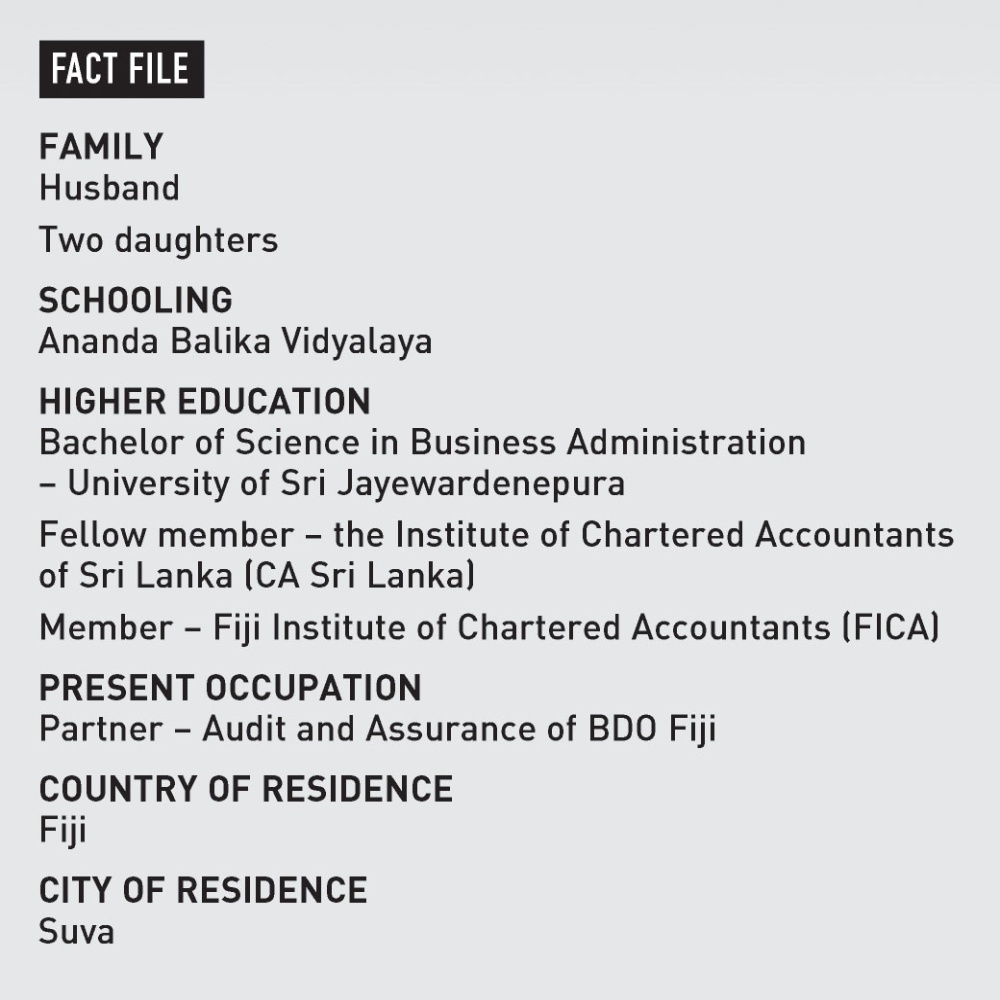
A: My move to Fiji was prompted by family, as my husband had worked here since 2004. I joined him after our marriage in 2008 and began my professional journey with BDO. What started as a personal decision soon became an enriching professional experience.
One of the key differences I observed between the two countries is the work culture. Fiji has a more relaxed and collaborative environment, with a strong emphasis on work-life balance and community values, compared to Sri Lanka’s fast-paced and hierarchical corporate culture.
Fijians are also known for their welcoming nature, which often translates into supportive professional relationships. Building trust and personal relationships plays an important role in business interactions, influenced by the prevalence of family owned businesses and hands-on ownership.
In contrast, Sri Lanka’s corporate environment is often more structured with clearer hierarchies and formal communication styles.

Q: How did your experience in Sri Lanka prepare you for the opportunities and challenges in the Fijian market?
A: My decade of experience in Sri Lanka, particularly with EY – where I progressed from audit trainee to senior manager – provided a strong foundation for my career in Fiji.
During this time, I developed technical expertise in audit and assurance, managing complex engagements and ensuring compliance with international standards – skills that proved invaluable when I transitioned into the Fijian market.
Working with clients across multiple industries in Sri Lanka built adaptability and a broad understanding of business environments. And leading audit teams strengthened my leadership and team management capabilities, which became particularly important when managing diverse teams and client engagements in Fiji.
Q: What unique challenges have you encountered while working across sectors such as telecommunications, banking and manufacturing?
A: Working across multiple sectors brings both complexity and opportunity, as each has unique regulatory, operational and technological considerations.
For example, the telecom sector evolves rapidly, requiring continuous adaptation to technological change alongside strict regulatory requirements. The banking sector is highly regulated with a focus on financial reporting, anti-money laundering compliance and risk management frameworks. Alternately, manufacturing businesses must balance operational efficiency with environmental and safety regulations.
Broader economic factors – including global market shifts, tourism fluctuations and natural disasters – also impact financial stability and strategic planning. Addressing these challenges requires a deep understanding of global best practices and local business dynamics.
Q: What trends or changes have you observed in the audit, tax and advisory sectors over the years?
A: The profession has evolved greatly over the past decade, driven by rapid technological advancements. Data analytics, automation and AI are increasingly used to enhance audit quality, improve efficiency and identify risks more effectively.
At the same time, regulatory expectations have intensified with a greater emphasis on transparency, stronger financial reporting standards and strict regulatory oversight.
Another important trend is the growing importance of non-financial reporting, particularly environmental, social and governance (ESG) considerations, as businesses are increasingly held accountable for sustainability and responsible corporate practices.
Q: How important is it for professionals in your field to adapt to different cultural and business environments?
A: Adaptability is essential in fields such as audit and advisory. Understanding different cultural and business environments enables professionals to communicate effectively, build trust and deliver solutions that are suited to local contexts.
Cultural awareness also improves problem solving, as each market has unique regulatory frameworks, business practices and stakeholder expectations. Professionals who navigate these differences are better equipped to add value to clients.
In today’s interconnected business environment, cultural competence is a key professional skill.
Q: What opportunities and challenges do you see for businesses operating in Fiji’s current economic climate?
A: Fiji presents several promising opportunities, particularly with the continued recovery of tourism, which is driving growth across hospitality, travel and related sectors. The country’s commitment to renewable energy and sustainability is also creating new investment opportunities.
Government investments in infrastructure development is improving connectivity and supporting long-term economic growth, while sectors such as agriculture and fisheries continue to show strong potential.
However, businesses must navigate certain challenges – including vulnerability to natural disasters, reliance on tourism and supply chain disruptions, all of which can create economic uncertainty. Access to finance can also be a constraint for SMEs.
Businesses that remain resilient, innovative and adaptable will be best positioned to capitalise on emerging opportunities while managing these risks.
