
Eroshan Meewella is redefining Sri Lankan dining through shared memories
Q: What inspired you to start Kolamba – and why did you feel London needed a restaurant such as this?
A: Honestly, it started from frustration more than inspiration. We had been in London for years and couldn’t find anything that reminded us of how we ate while growing up in Colombo. There were a handful of Sri Lankan places around but they weren’t telling the story we knew.
The food of the island is so varied; it changes from coast to coast, and family to family; yet. none of that was coming through anywhere.
We didn’t sit down one day and decide to open a restaurant; it was more that we kept saying someone should do this properly and eventually realised we were probably the people who had to do it.
Q: How did your personal journeys from Colombo to London shape the concept behind the restaurant?
A: Aushi and I have very different relationships with Sri Lanka, which I think shaped Kolamba in ways we didn’t fully anticipate.
I came to the UK when I was two, in 1976, so Sri Lanka for me has always been something inherited rather than lived. I know it through food, family, summers and visits.

Aushi grew up there and didn’t leave until university in 1997, so she carries it completely differently. She’s familiar with the rhythms of daily life, how a home kitchen actually works, what a meal there really looks and feels like – that turned out to be a useful combination.
I had the distance to ask how we explain this to someone who has never encountered it and Aushi had the authority to say that’s not how it actually is. Between us, we had something akin to the full picture.
Q: Your menu is rooted in family recipes. How did you curate the dishes that made the final cut?
A: We went back to people – relatives, old family friends and people whose kitchens we had eaten in across Sri Lanka. We asked what they cooked, how they cooked it, and why that dish and not another?
The menu took shape around the dishes that were impossible to leave out – the ones you couldn’t separate taste from memory. A crab preparation that existed in one particular family’s kitchen. A pol sambol made the way our mothers made it.
Some recipes are well known around the island while others are entirely specific to one household and have never existed anywhere else. For instance, our jaggery beef came from a friend’s family – it isn’t our recipe to claim but one we were trusted with and felt we had to share.
Q: How do you balance authenticity with adapting to a British market that may be new to Sri Lankan cuisine?
A: We don’t change the food. What we change is how we bring people into it.
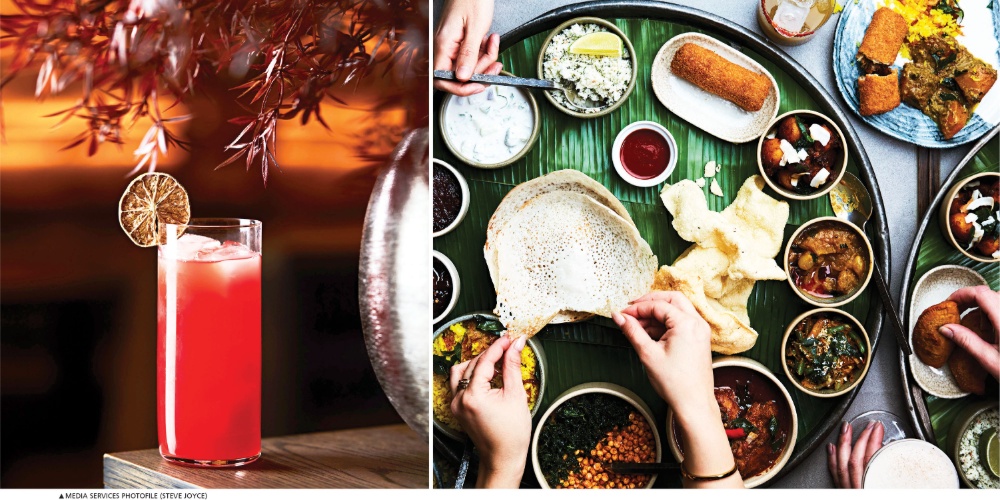
Many guests arrive at Kolamba slightly uncertain – they don’t know what to order, they’re not sure about the spice and they don’t know how dishes are meant to work together. And that’s understandable when the cuisine is unfamiliar.
We invest in guidance, both in the way the team presents the menu and through the Kolamba Favourites. The food stays exactly as it should and we make sure nobody feels lost in front of it.
Q: Are there any ingredients that were particularly challenging to source in the UK? And how do you maintain the integrity of Sri Lankan flavours despite these challenges?
A: Goraka took us a while. It’s a dried souring agent used extensively in southern Sri Lankan cooking – and it was almost impossible to find here. The same applies to certain dried fish and fresh pandan in consistent quality.
Our approach however, has never been to substitute anything. Sri Lankan flavour is built on very specific relationships between ingredients – the sourness, the coconut fat, the way spice develops over heat – and if you pull one thread, something fundamental unravels.
Because of that, we would rather take a dish off the menu than serve a version that doesn’t taste right.
Q: Your ethos speaks about community. How do you bring that to life in the restaurant?
A: The sharing format does a lot of the work on its own. When dishes arrive in the middle and everyone has to reach, something shifts and the meal becomes a conversation.
You’re recommending, negotiating, passing things across and it becomes harder to stay in your own world.
Beyond the table, we also think about how people feel when they walk in, whether they feel genuinely welcomed or just processed. The aim is always that a guest leaves feeling like they’ve been into something and not simply through it.
Q: Do you see Sri Lankan cuisine becoming more mainstream in the future?
A: Yes, and I think it has earned it. The cuisine has both the range and depth to sit alongside any of the great regional food traditions that have garnered an international audience.
But what I care about is that the version that goes mainstream is honest – not a simplified take that loses everything specific about it. That’s the risk with any cuisine that crosses over. Our job is to keep holding the line on what Sri Lankan food actually is and do it well enough that the standard it sets matters.
