
Unique cultural dynamics

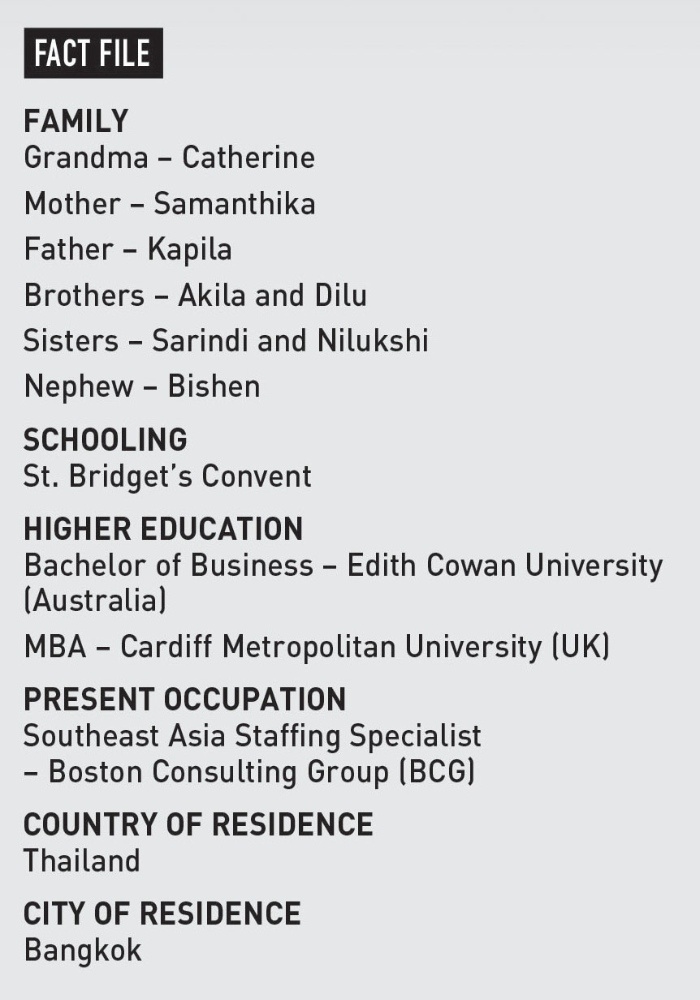
Q: What motivated your move from Sri Lanka to Thailand – and how has that transition influenced your professional outlook?
A: My move was driven by a desire for strategic expansion. While Sri Lanka provided a resilient foundation, Bangkok exposed me to the high velocity consulting and innovation landscape of Southeast Asia.
The experience shifted my outlook from local to regional and reinforced that talent strategy is not merely about filling roles but understanding and harmonising the unique cultural dynamics of different markets.
Q: How has your Sri Lankan identity influenced your approach to work and life overseas?
A: My identity is rooted in a culture of warmth, adaptability and perseverance. In the consulting world, where pressure can be high, I lean on the Sri Lankan philosophy of balance.
It has allowed me to approach complex problems with a calm and human centric lens. My heritage constantly reminds me that behind every strategy is a human being seeking connection and purpose.

Q: How does the work culture in Thailand differ from what you experienced in Sri Lanka?
A: Thailand has become my home away from home. Both cultures share warmth, hospitality and a deep respect for people, which made my transition feel natural.
Professionally, the rhythm is unique. Sri Lankan culture is passionate, agile and proactive in communications, while Thailand places an emphasis on consideration for others’ feelings and maintenance of social harmony through the beautiful concept of kreng jai.
Navigating these two worlds has taught me that you can achieve results while prioritising grace and harmony.
Q: What gaps do you see in how companies approach talent acquisition and staffing?
A: A persistent gap is what I call the ‘legacy filter’ – the tendency to hire for yesterday’s problems by over-indexing on pedigree over potential. In markets such as Southeast Asia, historical credentials are far less predictive of success than learning agility.
Boston Consulting Group (BCG) research highlights the urgent need to shift towards a skills based organisation model. In my experience, the real art of staffing involves the intentional alignment of a consultant’s development goals with organisational needs.
Many companies still seek perfect fits for rigid roles, when real value lies in hiring builders. Rather than finding someone who fits a box, the emphasis is on those who can help build it.
Organisations that fail to adopt this approach will struggle to compete for the region’s top talent.
Q: How is generative AI reshaping staffing and talent strategy in Southeast Asia specifically?
A: In Southeast Asia, generative AI is reshaping staffing into a skills first, cross border game.
Our research shows that the region is positioned to leapfrog in AI adoption but remains constrained by talent gaps, shifting hiring from pedigree to learning agility and continuous upskilling.
BCG’s ‘AI at Work’ survey also highlights strong bottom up adoption across the Asia-Pacific with 70 percent of frontline staff using AI regularly compared to 51 percent globally, pushing human resource teams to redesign workflows, governance and internal mobility.
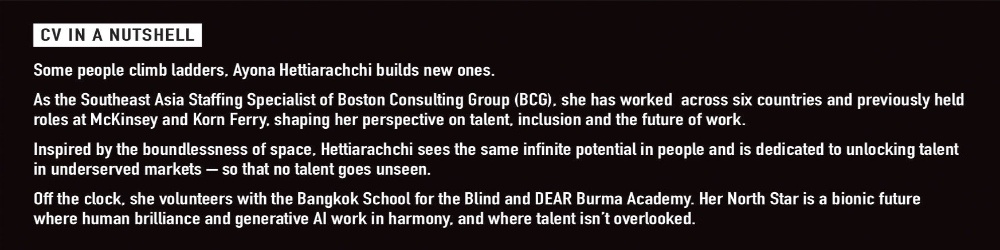
I see AI as a telescope that brings hidden talent into focus while leadership is the compass that turns that clarity into opportunity. For talent leaders, the priority is to make AI safe and useful for everyone, create pathways for overlooked potential and actively sponsor emerging leaders.
Q: How can organisations better prepare the next generation of leaders for uncertainty and rapid change?
A: In an era where uncertainty is constant, preparation lies in fostering resilience through agility and diversity.
A visit to NASA’s Kennedy Space Center a few years ago and witnessing a SpaceX launch made me realise that while technology is extraordinary, the true power lies in the human curiosity embedded in its culture.
This is also reflected in the recently successful Artemis II mission, where engineering excellence was matched by human collaboration across boundaries.
In this regard, diversity is not a buzzword but a requirement for survival and innovation. A ‘mission control’ model only works because experts with diverse perspectives solve problems from various angles.
This mindset aligns with BCG’s 10-20-70 principle, where 10 percent of effort goes to algorithms, 20 percent to technology, and a full 70 percent to people, processes and culture.
Our research reveals that when leaders provide strong support, employee positivity towards generative AI jumps from 15 to 55 percent. For future leaders, this means shifting from a command and control mindset to one of curiosity and coaching.
In a region as dynamic as ours, scalable leadership comes from treating every challenge as a human mission to be accomplished.
