
COMMUNITY EXPERIENCES
Henry Fitch discusses the growing demand for community led travel experiences

Community based tourism is gaining momentum worldwide as travellers increasingly seek meaningful, immersive experiences that directly benefit local communities. In Sri Lanka, the concept is especially relevant given the island’s rich culture, biodiversity and diverse rural communities. According to CEO of Teardrop Hotels Henry Fitch, community based tourism should be about far more than simply offering visitors a glimpse of local life.
“To me, community based tourism should be shaped by local people, rooted in culture and landscapes, and structured so that economic value remains within the community rather than simply passing through it,” he says.
Fitch believes local families should not merely serve as scenery for tourism experiences but instead play a central role in creating and sustaining them. “They are its architects, beneficiaries and, ultimately, guardians of its quality,” he notes.
He explains that the concept of community tourism in Sri Lanka has evolved considerably in recent years. What was once often limited to prearranged cultural shows for coach groups has gradually shifted towards more meaningful models that focus on grassroots benefits, destination development and nature or heritage led experiences.
“There is now greater emphasis on the grassroots benefit and destination development at the provincial level,” he says. For Fitch, the difference between genuine community based tourism and more superficial versions comes down to one key factor – ownership.
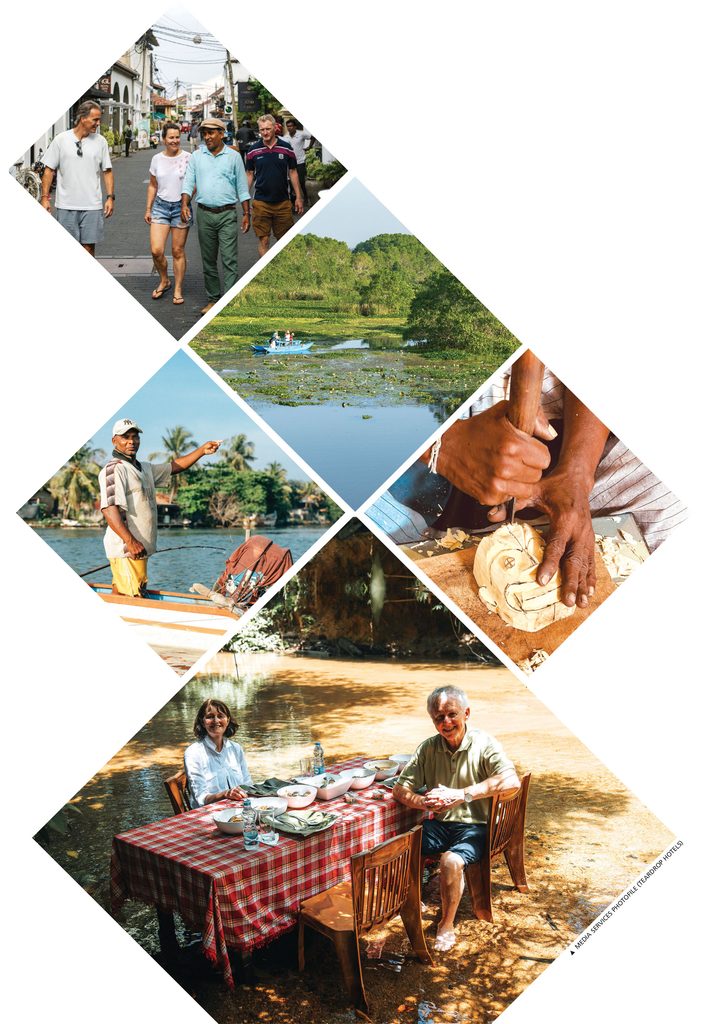
“The distinction is simple: authenticity begins with ownership, not aesthetics,” he states.
Fitch points to tea plucking experiences in the hill country, which are often romanticised for visitors. If communities are merely performing while outside operators capture most of the value, he argues, the experience cannot be considered truly community based.
By contrast, an authentic model is one in which communities have control over pricing, storytelling and the overall visitor experience. It should reflect real life, local skills, food, craft and knowledge, rather than something staged purely for consumption.
“They may partner with hotels such as Teardrop Hotels for distribution,” says Fitch, noting that the relationship should remain genuinely collaborative rather than extractive.
Fitch believes Sri Lanka is well positioned to succeed in this space. The country offers biodiversity, deeply rooted food traditions, artisanal heritage and a compact geography that allows travellers to move through very different communities within a single journey.
However, he shares that Sri Lanka has lagged behind some regional competitors when it comes to scaling such experiences. “Sri Lanka has often had the raw material but not always the infrastructure, training or coordination needed,” he avers.
He mentions that while tourism policy increasingly recognises inclusive growth and community participation, many initiatives still face practical barriers such as training, standards, market access, finance and coordination.
“In many parts of the island, the experience exists but the enabling ecosystem does not,” he explains.
This includes everything from roads and signage to digital discoverability, booking systems and quality assurance. A small guesthouse in Ella may find pathways to support but a fishing family in Mannar trying to develop a homestay often has few institutional options available.
Fitch says demand for community based experiences is real and growing with a segment of international travellers actively seeking immersion in local communities and valuing authentic, unstaged experiences.
“These visitors are typically well researched, comfortable with a degree of uncertainty and are willing to pay for something that feels genuinely unstaged,” he notes.
At the same time, demand still needs to be matched with better access and stronger product development. He believes community experiences must be integrated naturally into broader itineraries rather than treated as optional offerings.
“At Teardrop, we aim to ensure community engagement feels like a natural extension of place and not an add on,” he points out. Community based tourism can be resilient during times of crisis because it often operates with low fixed costs. A family homestay, for example, does not face the same overheads as a large hotel.
Fitch claims: “When arrivals dropped catastrophically in 2019 – and again during COVID-19 and the economic crisis – many community scale operators were able to suspend activity and return to other livelihoods.”
However, these same operators are also vulnerable because they rarely have financial buffers to withstand prolonged downturns.
Looking ahead, Fitch anticipates that community based initiatives will complement rather than compete with the mainstream tourism industry, helping to elevate the country’s overall travel profile.
“It will not replace mainstream tourism – nor should it – but it can become a meaningful pillar within a higher value tourism economy,” he observes.
For Sri Lanka, he believes the opportunity lies in attracting higher spending, longer staying visitors while spreading tourism benefits more widely across the island. “My belief – and Teardrop’s philosophy – is that tourism works best when local communities are invested in its success rather than subjected to its presence,” Fitch concludes.
