
Wijith DeChickera reviews Sri Lanka’s ongoing efforts to swim against the tidal waves of war with its precious – and precarious – stance of principled neutrality
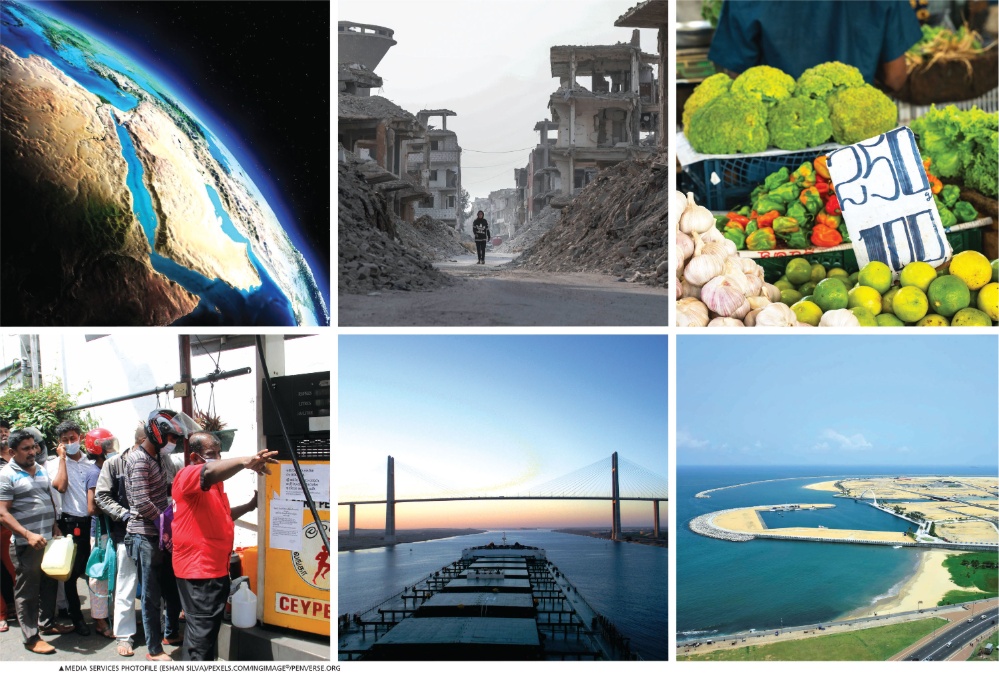
When distant wars redraw the map of our anxieties, small nation states such as ours quickly learn that geography is no longer destiny in a geopolitical dynamic that’s in constant flux. A conflict recently reached our shores in the quiet violence of oil, money and energy markets. When missiles arced across Middle Eastern skies and tankers smouldered in distant straits, the aftershocks arrived in Colombo as jacked up fuel costs, jumpy remittance flows and a jittery citizenry already wearied by austerity.
When crude oil prices surge, inflation spirals; and when supply chains are choked, fragile economies feel the pinch. For a small island nation tethered to imports and exposed to global currents, the deserts of West Asia were closer recently than our maps or policymakers cared to admit.
Sri Lanka’s recent navigation of the fallout from the US-Israeli conflict with Iran provided insights into the mindset of a state attempting to walk the tightrope of principled neutrality, presented appealingly enough in a humanitarian framing.
To some, it was a quiet diplomatic success; to others, it was a reminder of our constrained agency – a choreography dictated less by conviction than necessity. In such times, neutrality is not an abstract virtue; it’s a lived strategy for survival.
In the mid 20th century, then Ceylon was no passive bystander in shaping international norms. It played a prominent and pioneering role in the evolution of maritime law and multilateral diplomacy.
Its ambassadorial stalwarts contributed to early international conversations that eventually crystallised into frameworks such as the UN Convention on the Law of the Sea. It lent moral weight to the idea that the Indian Ocean should be a ‘zone of peace,’ free from great power rivalry and opportunistic militarisation.
Today, that vision is less clear; nor modern-day Sri Lanka’s voice as clarion. The Indian Ocean Region (IOR) is increasingly congested with competing naval presences, contested strategic ports and maritime passages and constricted shipping lanes. Perched as always at a vital maritime crossroads, we find ourselves both courted and constrained.
So has Colombo missed the opportunity to reclaim its convening power? Could it have rallied littoral states – from the Maldives to Mauritius – into a revitalised coalition for demilitarisation? Instead the island appears to oscillate between quiet diplomacy and strategic ambiguity, even as larger powers harden their positions.
Against this backdrop, Sri Lanka’s relationship with the West remains both indispensable and uneasy. The IMF’s Extended Fund Facility (EFF) has been a lifeline in times of economic freefall, binding Colombo to a reform agenda that is as politically sensitive as it is economically necessary.
Trade ties with Europe and North America continue to underpin export earnings, even as governance benchmarks and human rights concerns complicate the relationship. Yet, the world has shifted. Cold War binary certainties have given way to a multipolar contest.
The United States – and its perhaps dwindling number of allies – on one axis; and China’s expansive and expanding Belt and Road Initiative (BRI) ambitions on another; Russia asserting itself in defiance of Western sanctions; and emerging blocs such as Brazil, Russia, India, China and South Africa (BRICS) offering alternative alignments. In this fluid order, Sri Lanka’s calculus cannot afford to be static.
China remains a critical investor and infrastructure partner, its imprint visible from Hambantota harbour to Colombo Port City. India, by contrast, is the inescapable neighbour – a civilisational interlocutor and an increasingly assertive regional power with security concerns about its locus and backyard.
Balancing these two giants while maintaining credibility with Western partners is no small feat. It demands a diplomatic praxis that is not merely reactive but reasoned out and strategic, and also cautious while being suitably creative. Herein lies the crux of ‘Nonalignment 2.0.’
For Sri Lanka, this could mean reasserting its voice in regional forums such as SAARC – moribund though it may be – while exploring calibrated engagement with newer blocs such as BRICS.
It could also involve championing maritime governance and environmental stewardship within the IOR, reclaiming some of the moral leadership once associated with old Ceylon’s foreign policy.
Ultimately, the question is not whether Sri Lanka can remain nonaligned in a world milieu that increasingly demands allegiance. It is whether we can redefine nonalignment as an active, adaptive strategy – one that transforms vulnerability into leverage and geography into advantage.
