
Shavini Fernando
Innovation born from challenges
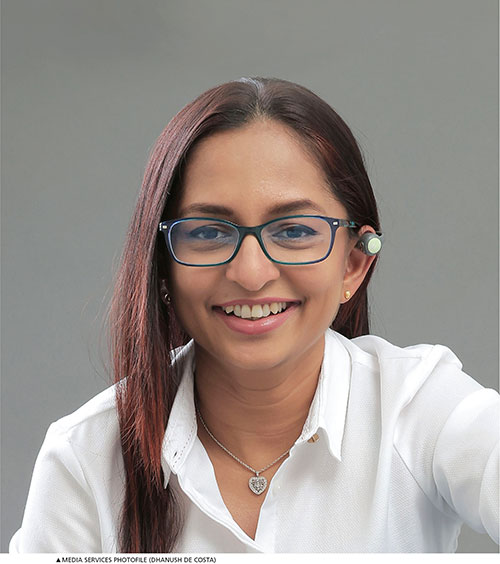
Q: When did you decide to channel your personal health challenges into building a medical wearable?
A: The turning point was realising that the absence of continuous oxygen monitoring had nearly cost me my life.
Diagnosed with Eisenmenger’s syndrome and severe pulmonary hypertension, doctors gave me two years to live. Dependent on oxygen, I survived four cardiac arrests and two strokes caused by silent drops.
Refusing to let my disease define me, I began prototyping OxiWear at Georgetown’s Maker Hub, guided by my doctor at Johns Hopkins. What began as a desperate lifeline became a mission to ensure that no patient, athlete or individual has to face the uncertainty of undetected oxygen drops.
OxiWear was born out of urgency but now represents possibility and the chance to live fully without being defined by disease.
Q: You’ve faced life-threatening situations firsthand. How did these experiences shape the urgency and design of OxiWear?
A: My experiences became the blueprint. The device had to be accurate during rest and motion, discreet and wearable 24/7.
Oxygen drops are silent; and once levels fall too low, you can’t call for help. OxiWear alerts users immediately, giving them time to act, apply oxygen, stabilise or share data with doctors.
Accuracy across all skin tones was also essential. Many oximeters failed on me because of my brown skin so I built OxiWear to work for everyone.
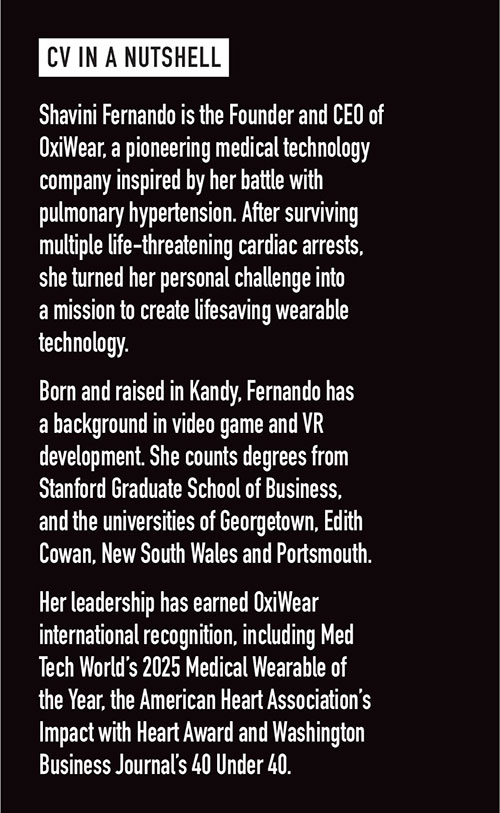
Q: What were the main hurdles in taking this from concept stage to a commercial product?
A: The first hurdle was figuring out how to begin. I wasn’t an entrepreneur – I was a video game developer.
Winning my first grant at Georgetown’s Bark Tank made me feel that people believe in me and I must now figure this out.
We built the first prototype but fundraising proved hard to come by. We raised US$ 200,000 before COVID-19 but couldn’t demo the product in person.
Many assumed Apple would solve this problem, not realising that patients need continuous monitoring cleared by the Food and Drug Administration (FDA). Only after Stanford and Harvard confirmed that Apple watches weren’t substitutes did investors begin listening.
Then came the FDA hurdles – convincing it of the need for accuracy across skin tones took nearly a year. Even after clearance, challenges of commercialisation, audits and investor demands remain.
Q: So what sets OxiWear apart from other devices on the market?
A: OxiWear is the first FDA 510(K) cleared ear worn device that continuously measures oxygen and the pulse rate accurately during both rest and motion, and across all skin tones.
Beyond accuracy, it’s about inclusivity and design – it is discreet, comfortable and fits seamlessly into daily life.
Q: As a female founder from Sri Lanka leading a med-tech company in the US, what challenges and opportunities have you encountered?
A: As a female founder from Sri Lanka, I faced unique challenges. I first arrived in the US on a tourist visa for treatment and was told I couldn’t return home. To stay, I pursued another master’s at Georgetown University and navigated visa restrictions while building OxiWear. With support from lawyers and the university, I secured an O1 visa based on my patents and later my EB-1 green card.
Funding was a major barrier. I couldn’t access National Institutes of Health grants, so I had to rely on private investments. As a solo founder, I faced pressure to bring on a co-founder, often with bias against my background.
Despite these challenges, I remained determined, turning obstacles into motivation to build OxiWear. To date, we have raised US$ 10 million and OxiWear is valued at 38 million dollars.
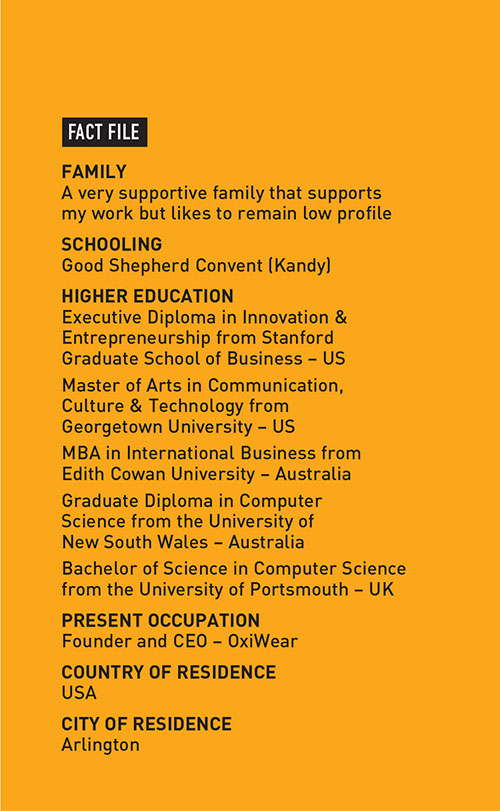
Q: What legacy do you hope to create through your work?
A: Honestly, I don’t think about legacy. I’m not doing this for recognition – I do it because nothing compares to seeing how we’ve improved someone’s life. You can’t put a price on a patient’s smile.
That comes from my Sri Lankan and Buddhist upbringing: the belief that you reap what you sow. Sri Lankans are hardworking, adaptable and willing to innovate. Resilience and optimism are part of who we are.
My message to young Sri Lankan innovators is that if you have an idea, pursue it. There will always be naysayers but use their doubt as fuel. Let challenges become catalysts and stay focussed on your end goal.
