
The Sri Lankan diaspora today is stronger than ever
Jayampathi Perera
Collaborate rather than compete
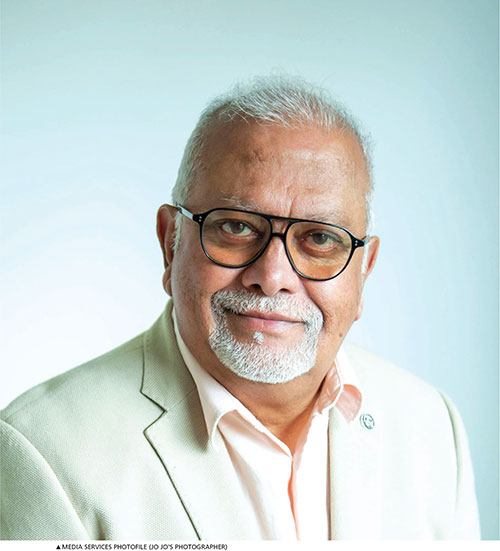
Q: What inspired you to pursue a career in international marketing?
A: It was the mid 1970s, a time when most Sri Lankan parents wanted their children to become either doctors or engineers and very few other career paths were recognised.
Based on her research, my sister suggested I enrol at the Institute of Marketing (UK) to study marketing, which was an unknown subject in Sri Lanka at the time.
For me, it was completely new. Exams were conducted directly by the Institute of Marketing and we were thrown into the deep end, armed with very little knowledge of how marketing worked in the developed world.
At the time, marketing in Sri Lanka was still in its infancy. People shopped at small independent family stores, as supermarkets didn’t exist.
Advertising was basic and television – let alone the concept of electronic media – hadn’t arrived in the country. It was a different environment, and studying marketing within it was both a challenge and an eye-opener.
Q: What were the most pivotal moments that shaped your career in the UK and internationally?
A: Arriving in London as a student with limited resources was a turning point. Sri Lankans were not allowed foreign exchange at the time, so I relied on financial support from my sister (who was working in the UK) as well as part-time work.
During my studies, my senior lecturer Dr. Leister Massingham – a respected marketing consultant in the UK and later, the Chief Examiner at the Institute of Marketing – recognised my potential and guided me.
He encouraged me to pursue a specialised advertising course with the Communication, Advertising and Marketing (CAM) Foundation in London, and I believe I was the first Sri Lankan to complete it in 1983.
Breaking into the UK’s marketing and advertising world was a challenge. Initially, ethnicity was a barrier but I soon realised that opportunities existed in companies looking beyond the domestic market.
I focussed on organisations targeting overseas markets, particularly in regions experiencing rapid economic growth. One such company gave me the breakthrough I needed, allowing me to concentrate on the Middle East and China.
That marked the beginning of my career success.

Q: Having chaired both the UK-Sri Lanka Business Council and British Sri Lanka Chamber of Commerce, what leadership lessons stand out from those roles?
A: My leadership was instrumental in promoting bilateral trade and investment between the two nations. Working closely with government bodies meant navigating an ever changing political climate, inconsistent decision making and administrative challenges that often slowed progress.
My direct approach – challenging officials who introduced unnecessary barriers for political or personal gain – sometimes paid off. What I learned was that persistence, determination and patience are key when driving change.
Q: What are the challenges Sri Lanka has faced in promoting trade and investment internationally?
A: Internationally, rising US tariffs, escalating global raw material prices, declining consumer demand in Europe, and a shortage of globally competitive and locally manufactured products have made export growth difficult to come by.
On the domestic front, attracting overseas investors requires urgent reforms – specifically in
reducing high manufacturing cost and addressing increasing energy prices.
Q: What are Sri Lanka’s competitive advantages? And how can they be better leveraged internationally?
A: With limited natural resources and declining exports, Sri Lanka is in a difficult predicament.
Given India’s extraordinary pace of development, forming strong trading and manufacturing alliances with it will be crucial to maximising our benefits. While we publicise our independence and unique geopolitical identity, collaboration rather than competition may be the key to securing long-term growth.
And with Sri Lanka enjoying lower US tariffs than India, we should be attracting Indian investors with the capital and scale to drive large-scale growth.
Q: How can Sri Lanka’s diaspora contribute more to international trade and investment?
A: The Sri Lankan diaspora today is stronger than ever – they’repositioned to help our nation rise from its economic challenges and chart a path towards growth.
They hold advanced technological expertise, invaluable insights and access to the financial resources that Sri Lanka urgently needs.
Yet, to unlock this potential, the island must create an environment built on trust, and defined by structured policies of transparency, accountability and good governance. Only then can we inspire our community to return, reinvest and reimagine Sri Lanka’s future.
