
Dr. Charith Peris
Navigating AI’s next frontier
My focus is on responsible AI, which involves ensuring safety and policy adherence throughout the artificial intelligence lifecycle
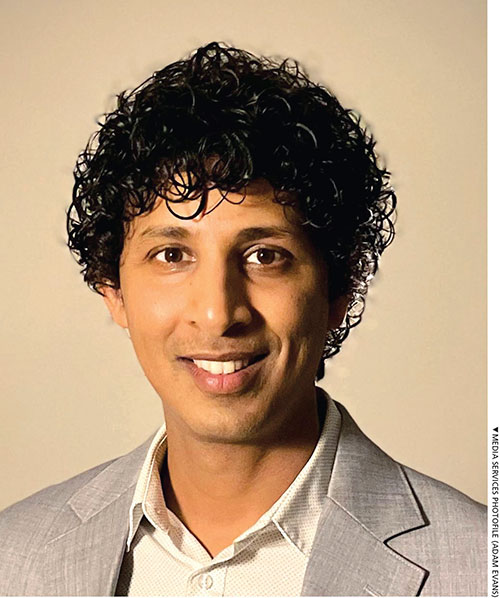
Dr. Charith Peris is a Senior Applied Scientist in the Nova responsible-AI team within Amazon’s Artificial General Intelligence (AGI) organisation. AGI’s mission is to pioneer the development of artificial general intelligence systems and capabilities, starting with generative AI.
Within this organisation, Peris leads a team focussed on making foundational artificial intelligence models responsible through high quality, policy compliant data collection at scale and experimentation with a range of reinforcement learning strategies.
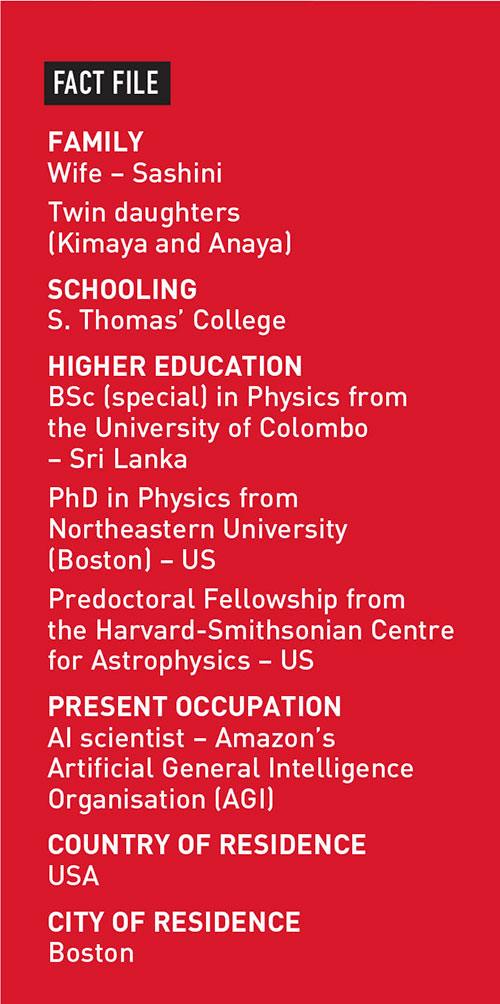
Peris completed his PhD in Physics at the Northeastern University in Boston, Massachusetts, while holding a predoctoral fellowship at the Harvard-Smithsonian Centre for Astrophysics.
Q: As an AI scientist, how would you describe what you do? And what role do you play in shaping the development of AI today?
A: Artificial intelligence scientists work on the bleeding edge of AI research, developing technology that can be used to build better foundational models and artificial intelligence systems.
I work within Amazon’s AGI organisation, which comprises a team of AI scientists, engineers and specialists from a range of disciplines that are building Amazon Nova – a family of state-of-the-art foundational models.
My focus is on responsible AI, which involves ensuring safety and policy adherence throughout the artificial intelligence lifecycle. Our team engages in policy compliant data collection, responsible foundational model training, bias audits, red teaming and building guardrails for AI systems.
At the frontier, this also includes anticipating longer-term alignment challenges such as the controllability of super intelligent AI when it eventually arises.
Sri Lanka should invest in a clear AI road map aligned with national goals such as agriculture, healthcare and education
Q: What initially drew you to the field of astrophysics – and later, what motivated the shift into AI and deep learning?
A: As a child, I was fascinated by two things – dinosaurs and black holes. The opportunity to work on either of those would have been amazing.
A few months after starting my PhD in Physics, I attended a department barbecue and happened to meet a scientist from the Harvard-Smithsonian Centre for Astrophysics. She was discussing imaging galactic black holes hundreds of light years away – it was absolutely fascinating!
As she was leaving, I made a split second decision to run up and ask if I could connect to learn more about her work.
That decision led to a volunteer research position and ultimately, to winning a predoctoral fellowship at the Harvard-Smithsonian Centre for Astrophysics to study black holes and neutron stars.
My shift to deep learning came as more of a practical choice. Astrophysics is a very niche subject with limited funding and I was faced with the dilemma of spending a lifetime fighting for tenure track academic positions versus moving to industry to take on the ‘hot topic’ at that time: data science and machine learning.
I chose the latter, which led me to work for Amazon Alexa in the field of natural language understanding. I never shifted into what we now refer to as generative AI. However, as part of my work in natural language understanding, I was already working on safety for large language models within Alexa – long before the ChatGPT explosion happened.
So, it was more like generative AI (which essentially grew out of the field of natural language understanding) shifted into me.

Q: Which industries do you expect will be most disrupted by responsible AI – and why?
A: I expect the industries most disrupted by responsible AI will be those where trust, safety and fairness are of ultimate importance to their license to operate.
Healthcare will see disruption as responsible AI becomes essential for ensuring diagnostic equity and protecting patient rights and privacy. Finance will need it to guard against bias in lending, insurance and fraud detection.
And social media platforms will likely adopt responsible AI to prevent bullying, police child exploitation and generate suicide prevention responses. These domains will have tangible benefits by making their artificial intelligence systems responsible.
Ultimately, I believe responsible AI won’t be a compliance obligation but a differentiator – with organisations that embrace it early gaining a trust advantage in their industries.
I believe responsible AI won’t be a compliance obligation but a differentiator
Q: Where do you see the most promising industry applications of multimodal large language models (MLLMs) in the next two to three years?
A: MLLMs will have the greatest impact in domains where video, audio, image and text can come together to support real-time decision making.
For example, in self-driving vehicles, MLLMs can combine video from cameras, audio from the environment and natural language or voice instructions, to improve navigation, travel planning and human vehicle interaction.
In healthcare, multimodal large language models might combine signals from wearable devices, scans and X rays, clinical notes and doctor-patient conversations to provide real-time decision support.
Ultimately, MLLMs will evolve from tools into agents that perceive the world, reason and act without supervision – just like humans do; and they will support humans across a range of industries.
Q: Looking back at your PhD work, what were the most surprising insights you discovered about black holes or neutron stars?
A: One surprising result was learning how fast these objects moved. I studied an X ray binary system consisting of a normal star – similar to our sun – orbiting a black hole. The black hole was pulling in gases from the star’s atmosphere, which formed an enormous disk around it.
By modelling the luminosity emitted from this disk, we were able to confirm that the black hole was spinning at 98 percent the speed of light. For those who are unfamiliar, this is an extremely high rotational speed for such a massive object.

Q: What specific policy areas in Sri Lanka do you think would benefit most from data driven decision making? And how are we making use of data right now?
A: I think any policy area could use data driven decision making. Some areas such as poverty could see immediate gains by investing more in data driven decision making. For example, currently data from the household income and expenditure survey is used for poverty calculation and social welfare targeting. However, these surveys can have biases due to sampling issues, which may lead to erroneous conclusions.
As part of my work as an advisor to the non-profit think tank Advocata, we explore the use of night light intensity and building counts from satellite data as auxiliary variables to identify poverty-stricken communities in Sri Lanka.
These indicators are independent of common survey biases and are also easily accessible. Combined with existing methods, they can help better calculate poverty and improve alleviation efforts such as social welfare dissemination.
Q: What are your thoughts on how Sri Lanka should embrace AI?
A: Sri Lanka should invest in a clear AI road map aligned with national goals such as agriculture, healthcare and education, starting with cost effective cloud partnerships rather than expensive local data centres.
It should prioritise AI for public benefit – for instance, disaster relief, poverty alleviation, disease prediction and wildlife protection.
If Sri Lanka leverages its diaspora and positions itself as a testbed for responsible AI in emerging markets, I believe the country can attract funding and collaborations, and leapfrog into global competitiveness.

