
Duleesha Kulasooriya
Making sense of ‘the edges of change’
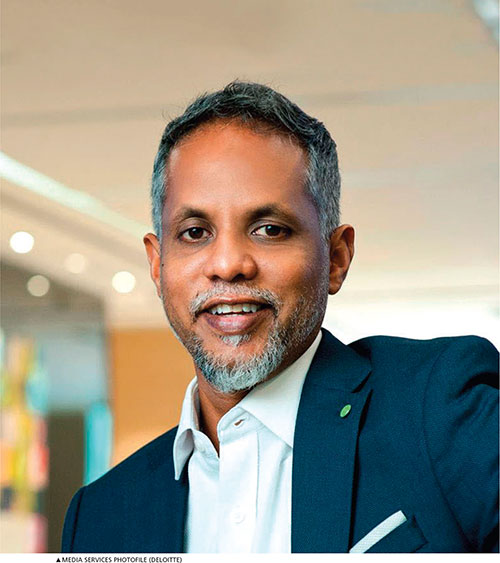
Q: You’ve lived and worked in Sri Lanka, the US and now Singapore. How have these experiences influenced your perspective on leadership and innovation in today’s world?
A: Growing up in Sri Lanka gave me an appreciation of resilience and community.
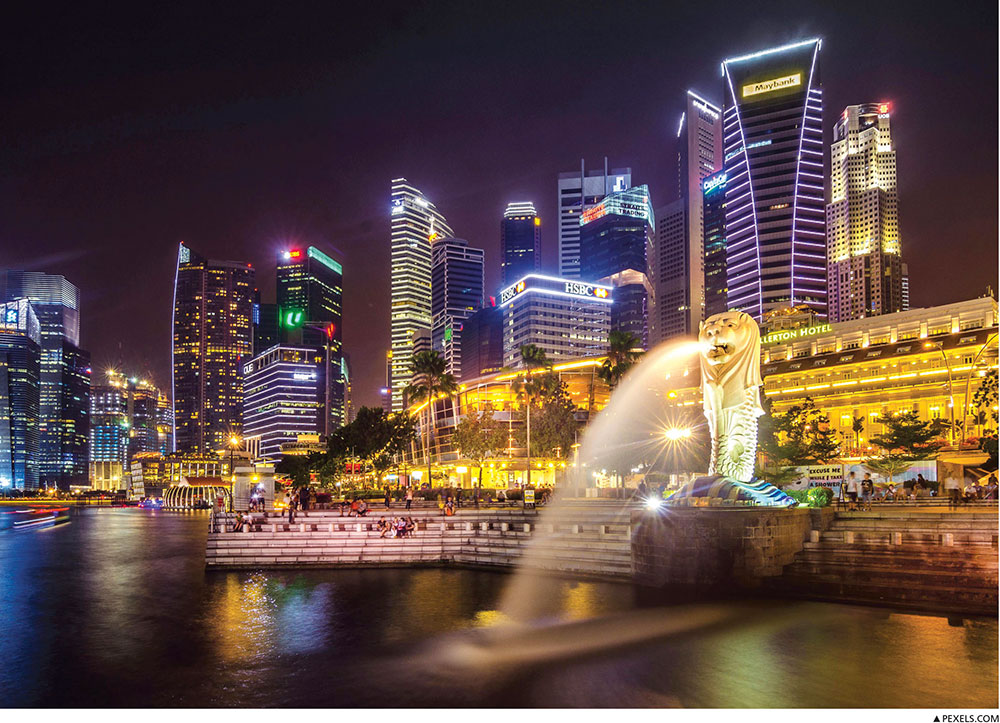
Meanwhile, my time in the United States exposed me to an entirely different ecosystem – it taught me to think big and embrace experimentation. Singapore has added another layer of thinking – it has sharpened my sense of pragmatism and thinking along the lines of systems.
Together, these experiences have shaped my approach to innovation as being both deeply human and globally connected – i.e. balancing bold ideas with grounded, practical execution.
Q: What drew you to lead Deloitte’s Centre for the Edge in the Asia-Pacific? And where has this taken you to date?
A: Early in my career, I realised that consulting often focussed on the present while my real curiosity was in exploring what’s next.
The Centre for the Edge gave me the mandate to do exactly that: to study emerging trends – what I call the ‘edges of change’ – from artificial intelligence to space technologies, and translate them into strategies that businesses and governments can act on today.
It’s a perfect intersection of research, foresight and applied innovation.
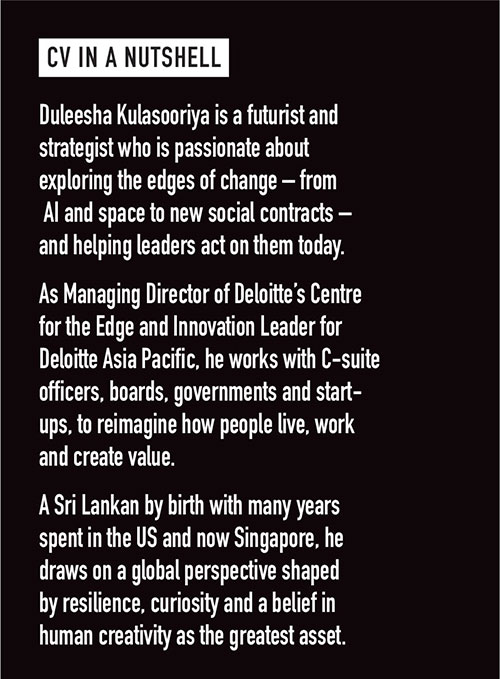
Q: You’ve written extensively about edges such as the Maker Movement, sharing economies and transformative tech. Which emerging edge do you see as being most critical for the Asia-Pacific region today?
A: Without doubt, AI enabled work is the most transformative edge. But beyond technology, I’d say the rethinking of social contracts – i.e. how societies provide care, opportunities and security in an era of fragmented and flexible work – will define the next decade.
The Asia-Pacific, with its vast diversity of demographics, cultures and governance models, is a fascinating laboratory for these experiments.
Q: If you were to update the shift index for 2025, what new signals would you track?
A: I would focus on three areas…
First, the spread of generative artificial intelligence into everyday workflows.
Second, the rise of digital nomad infrastructures and global mobility, which signal shifts in talent distribution and urban planning.
And third, the early formation of decentralised governance models, from decentralised autonomous organisations (DAOs) to network states. These are not only technologies but social indicators of how people are reorganising themselves for the future.
Q: With artificial intelligence and automation advancing so rapidly, what is the biggest opportunity and risk for businesses in Asia?
A: The biggest opportunity is unleashing creativity. By freeing people from repetitive tasks, AI allows them to focus on design, innovation and problem-solving.
At the same time, the risk is that without intentional policies and careful design, we create fragile systems – for example, work that is flexible but insecure and opportunities that are abundant but inequitable.
The winners will be organisations that design off ramps and on ramps into this AI driven economy.
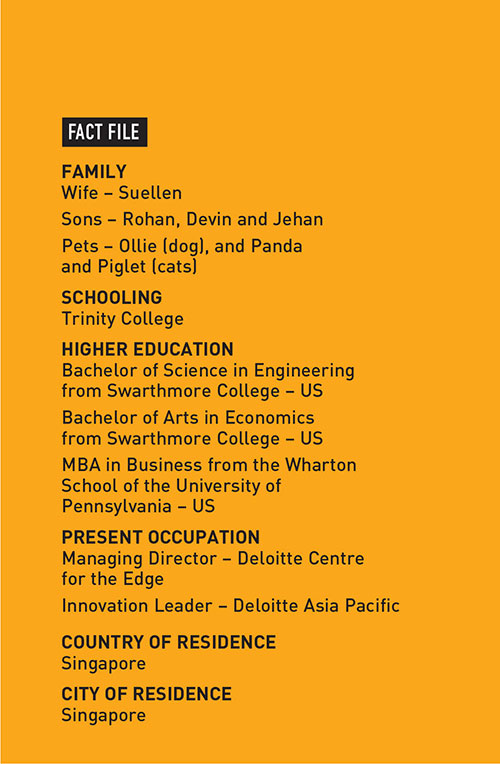
Q: How can traditional companies in Sri Lanka embrace innovation without losing their core identity?
A: Innovation doesn’t have to replace heritage; it should amplify it – and so tradition should be reframed as an asset rather than a constraint.
Companies can innovate at the edges – e.g. through partnerships, pilots or spin offs – while staying true to their heritage. Sri Lankan firms have authenticity and cultural depth, and innovation should leverage these strengths – not erase them.
Q: And last but not least, do you think that small nations such as Sri Lanka can leapfrog in innovation or is scale always an advantage?
A: Small nations can absolutely leapfrog. In fact, size can be a strength – it enables agility, rapid experimentation and faster policy shifts.
Estonia, Israel and Singapore have all shown that focussed strategy, niche specialisation and bold experimentation can overcome scale disadvantages.
For Sri Lanka, focussing on niches such as sustainability, digital nomadism or creative industries could position it uniquely on the global map – and allow it to compete with much larger economies.
