
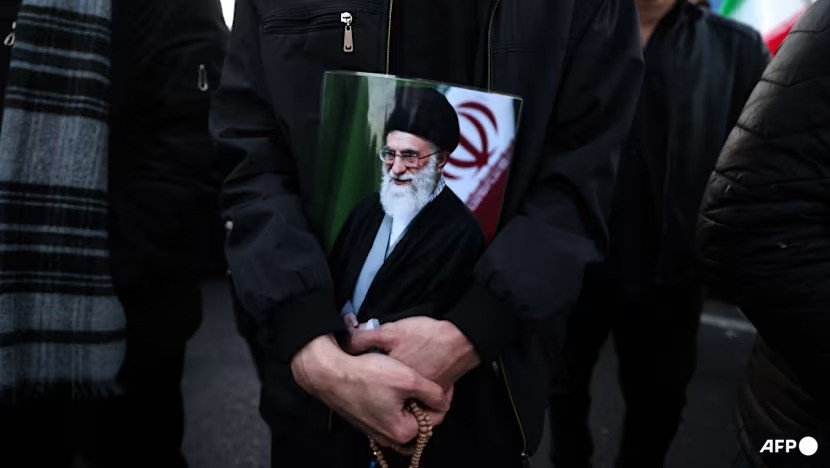
Despite mounting speculation about regime change, analysts warn that without boots on the ground, any meaningful shift in Iran is more likely to stem from internal power dynamics than from external pressure.
A US-Israeli strike that killed Iran’s Supreme Leader Ayatollah Ali Khamenei has thrust the Islamic republic into one of its most uncertain moments in decades, raising questions over succession and the risk of wider regional escalation, analysts say.
CNA: Mar 1, 2026
Khamenei was working in his office in Tehran at the time of Saturday’s (Feb 28) attack, state media said, which also killed his daughter, grandchild, daughter-in-law and son-in-law. The attack also targeted senior Iranian leadership.
The development is a major blow to Iran because “there is no successor”, said Cedomir Nestorovic, professor of geopolitics at ESSEC Business School Asia Pacific, warning that “all the cards are on the table”.
While he believes the country’s Islamic Revolutionary Guard Corps (IRGC), government and parliament “will do their best in order to make some kind of successor continuation”, he said it will take a “long time” before another leader is named.
