
Ranuka Dharmaratne
Bridging cultures through finance
Q: What drew you to the field of accountancy and finance – and how did your Sri Lankan roots influence your career path?
A: From a young age, I was fascinated by how numbers could tell a story; not only of businesses but of people, decisions and outcomes.
Growing up in Sri Lanka, I was surrounded by a culture that values discipline, education and perseverance. These values shaped my work ethic, and inspired me to pursue accounting and finance as a profession.
My Sri Lankan roots gave me the determination to succeed internationally while staying grounded in the principles that first inspired me.
Q: Looking back, what was the most challenging transition in your career – and how did you overcome it?
A: The most challenging transition was moving from Sri Lanka to the North American professional landscape. Establishing myself in Toronto – which is one of the world’s most multicultural cities – required me to adapt to new norms in communication, leadership and professional expectations.
It was overwhelming at first; but I overcame it by embracing every experience as a learning opportunity and continuously pushing beyond my comfort zone.
What initially felt like a barrier became a strength because it taught me how to bridge cultural differences and bring a global perspective to my work.
Q: What does being named a CPA Ontario Emerging Leader 2024 mean to you – both professionally and personally?
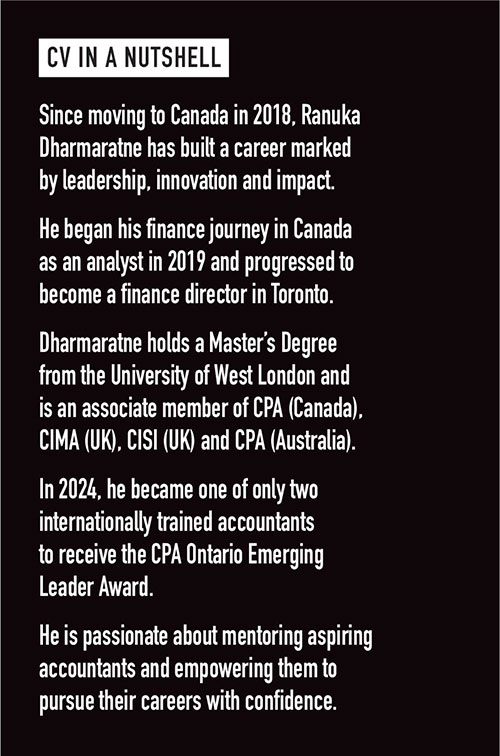
A: Professionally, it’s recognition of years of dedication, leadership and innovation.
Personally, it carries even more weight – being one of only two internationally trained accountants to receive this honour is proof that resilience and belief can turn challenges into milestones.
The award reflects the journey of countless immigrant professionals who persevere against the odds; it is both a validation and responsibility to continue leading, innovating and opening doors for others to follow.
Q: As the driving force behind a real-time financial consolidation tool, what motivated you to embark on this initiative? And how do you envision it influencing the evolution of financial reporting?
A: My motivation came from observing the inefficiencies and frustrations finance teams face, during consolidation and reporting cycles.
I wanted to develop a solution that not only reduces time but also enhances accuracy and transparency. Real-time consolidation empowers decision makers with instant insights. It transforms finance from a reactive function into a proactive partner in strategy.
Innovations such as this will define the future of financial reporting where speed, reliability, and integration with AI driven analytics become the standard rather than the exception.

Q: How do you balance traditional accounting principles with the adoption of new technologies such as automation and AI?
A: Accounting principles are about integrity, consistency and accountability. These fundamentals never change. What evolves are the tools we use to uphold them.
I consider automation and artificial intelligence not as replacements but amplifiers of our profession. They enable us to reduce repetitive tasks and focus our attention on judgement, ethics and strategic areas where human expertise remains irreplaceable.
The balance lies in embracing innovation without compromising the principles that govern the credibility of our work.
Q: What do you find most rewarding about mentoring new CPAs and students?
A: The most rewarding aspect is seeing potential transform into confidence.
Many Sri Lankan students and new CPAs have doubts about their abilities – or uncertainty about their career paths. Through mentorship, I help them recognise that challenges are opportunities in disguise and that resilience is just as important as technical skills.
Mentorship is about building a strong community where I can freely share knowledge, encouragement and opportunities. Seeing mentees succeed and grow is one of the most fulfilling aspects of my journey.
Q: What challenges or opportunities do Sri Lankan professionals face when transitioning into international careers?
A: Transitioning to an international career often means proving the value of your Sri Lankan qualifications and experience in a completely new context. At first, this can feel daunting but these challenges help build resilience.
Sri Lankan professionals bring qualities that – when combined with global exposure – become real differentiators. What may start as an uphill climb often becomes an advantage, enabling them to bridge cultures, adapt quickly and bring unique perspectives to leadership on the international stage.
